


The price to park your car for an hour in the Millennium Park Garage has risen 31 percent, to $17, since the garage was leased to Morgan Stanley in 2006.
The cost to drive an auto across the Chicago Skyway is now 50 percent higher than it was in 2004, when Australian and Spanish investors paid $1.83 billion for a 99-year lease.
Could an $8 airport pretzel be next? How about a $10 luggage cart?
Those are real questions facing consumers as the city moves ahead on a landmark plan to lease Midway Airport to private operators.
1/05/2010
Vote for a True Hero: Bill Gammon for Judge!
I need to tell you about a great opportunity we have to help a true hero of the people get into a position to make a real difference for the people once again. As you most probably know, Bill Gammon has been behind the scenes spending many hundreds of hours fighting freeway tolls via the legal system (pro bono) since 2004.
Thanks to Bill Gammon's legal expertise we stopped many double tax freeway tolls in Central Texas!

Our friend and attorney Bill Gammon is running for judge in the democratic primary for the 147th judicial district court (If you live in Travis County you can vote in the Dem Primary for Bill!). Bill has decided to run without seeking campaign contributions as he feels that they tarnish a judicial race.
The primary is only 2 months away. Bill only has one opponent and no Republican opponent in the general election so the primary is for all the marbles.
I've never met anyone that has been so dedicated to the "regular Joe" in all my life.
Feel free to copy and paste the body of this message and send it to people you know. Get the word out and make sure people vote for Bill in the Dem primary!
Take Care!
Thank You!
Sal Costello
7/09/2009
Update from Sal
 Hey pals!
Just a quick update. I think I'm getting to where I wanted to be when I left Austin about a year ago.
Between my recent vacation (my first one in 2 years) and this fantastic book called "The Joy of Living" by Mingyur Rinpoche, I've stumbled upon a major reset in my life.
Buddhist master Rinpoche combines Buddhist wisdom with the latest breakthroughs in Western medicine to reveal the scientific basis for how one can achieve enlightenment, relaxation, and happiness through meditation. I love every page.
Also, I'm on facebook. So, if you are looking to know what I'm up to, you'll find updates there if you want to select me as a friend.
: )
3/13/2009
YOU pay for the Toll Tax Bureaucracy
News 8 Austin has a great report called "Toll road billing continues to take its toll on drivers", read the whole article HERE.
"The complaints were so varied and complicated, we had to break them down into recurring themes.The complaints most prevalent include: accusations of inaccurate billing, exorbitant administrative fees, inaccurate record keeping and promises made by customer service that were not fulfilled.
To be fair, these claims have yet to be substantiated.
For weeks, News 8 has asked TxDOT to respond to these claims. We were told Turnpike Authority Director Mark Tomlinson was just too busy to talk to us.
We wouldn't settle for talking to one of TxDOT's media representatives because, by their own admission, one of them had already given us inaccurate information.
We took the e-mails to TxDOT to be presented to Tomlinson. News 8's Bob Robuck delivered a packet of e-mails, with names and contact information redacted.
We included a note that we would get in contact later this week.
And, remember Lisa Coleman, who TxDOT billed for nearly $4,000, and Samone Murray, billed for more than $11,000?
A TxDOT spokesperson told us each woman received an offer to have her penalties forgiven as long as she paid the tolls.
Murray said no one made her such a deal and Coleman claims customer service made the offer at the very beginning of her nightmare, when TxDOT couldn't provide documentation that she even owed the tolls."
1/30/2009
Governor Rick Perry Slanders Me
 The Texas Governor, Rick Perry, must be obsessed with me.
Months after I moved out of Texas, the Governor of Texas is spinning tales about me to to the Dallas Morning News. Perry says I tried to make a living off opposing the corridor, and since I couldn't do so, I had to leave Texas.
What a crooked liar!
Perry says this in the article:
"....And if the grass-roots toll groups and bloggers had substantial influence, we wouldn’t be building any roads at all — they would have killed (our efforts) — and we are. Sal Costello had to move out of the state, it got to be such a poor way to make a living."The writer Michael A. Lindenberger, of the Dallas Morning News, deserves credit, as he tries to set the record straight within the article (although he's off by a couple of months with when my announcement took place) — But it's a better effort than the toll loving Austin American Statesman would ever do (Otherwise known as the Snakesman). Dallas news says this after Perry reimagines the facts:
"Note: Costello, founder of a group called Austin Toll Party, is credited with helping stop some taxpayer-funded roads in Austin from being converted to toll roads. His blistering attacks made him a prolific anti-toll road gadfly. He announced earlier this month he had moved to a small town in Illinois and given up what he called his costly “obsession” with campaigning against toll roads."
1/27/2009
Search 1,000's of Muckraker articles via this MEGA-Muckraker search engine!
I hope you are all well.
We are doing well here.
Just CLICK HERE for the MEGA-Muckraker search engine! Type in Kirk Watson, TTC, Pete Peters, Dawnna Dukes, TxDOT, Brewster McCracken, Mark Strama and more to get your Muckraker fix at anytime.
Your Pal Sal
: )
12/10/2008
Something to add
Something has really been under my skin since that Ben Wear/Statesman article below (about me leaving town).
Ben called me many times for interviews since 2004.
Just a few months back Ben Wear complimented me on breaking so many stories on my blog. But, in his article, he suggests I didn't have my facts straight, at times. He specifies that my facts on Mike Heiligenstein, executive director of the freeway tolling authority (CTRMA), being a "Deadbeat" was not correct.
The fact is Mike Heiligenstein is a friend of one of the editors of the Austin American Statesman.
My article even lists the case # so you can call the county to verify Anne Heiligenstein filed a "Income Witholding for Child Support" petition in Williamson County to force Mike Heiligenstein to pay $1,500 a month in child support.
11/26/2008
11/17/2008
Statesman's perspective, "Anti-toll guerrilla has moved on down the road"
11/09/2008
I Say Good-bye.
To all my friends, I say good-bye in this final post to my muckraker blog.
In 2004 I wondered if I could stop a toll tax on a 100% tax paid bridge near my home. Within a year, I found out that with a lot of hard work and a community of friends, together we could.
As is human nature, to always want more, I wanted to ax more freeway tolls from the Gov. Rick Perry/Sen. Kirk Watson double tax plans for Austin and Texas.
Success can take a toll on other areas of one’s life.
I would eat and sleep the fight for about four years, doing just enough to hold on to everything else as the months slipped away. A number of times that obsession came too close to taking my family and my home from me.
I decided to move on.
In early July we put our home up for sale and received a cash offer in 10 days. Part of the deal was a super fast closing. So within three weeks we went from a sign in the front yard to driving away in a U-Haul filled with everything we own towards Southern Illinois.
My new priorities are my health, my family and maximizing the efficiency of our 5 year old solar passive home.
I realized the other day that I moved from a city with 1,000,000 people to a town of 400.
There are moments that I feel some culture shock, but other than that, just about everything else is falling into place. Just day’s after moving here I created a rewarding working relationship with an organization in a nearby town that does great things for individuals and families in need.
I get to help my new community and I get paid for it.
To my past enemies: Those politicians who ignore the public will and have yet to be fired. I don’t wish evil on you. I don’t have to. I believe that the natural order of the world will take care of you just fine.
To all my great friends, I wish you all the best.
And, I say good-bye.
: )
UPDATE: The corrupt Austin Chronicle has tried to insult me with their latest article. Here is WHY.
11/07/2008
11/05/2008
Toller Travis County Commissioner Gerald Daugherty FIRED! My next to last post.
 TOLLER GERALD DAUGHERTY FIRED!
Daugherty, one of this years "Sleazy Six", who voted to toll roads we've already paid for in Austin, TX was my districts county Commish. Early in 2004 he voted against the toll roads, but from 2005 on he voted YES every single time. Ignoring the public outcry against tolling our public highways.
Last night he lost his re-election! Yeah! From the Statesman this morning:
Daugherty met the fate of many stubborn elected officials who refuse to listed to the people they pretend to serve. Such as commish Karen Sonleitner, Mayor Dwight Thompson, and others. And many other crooks like Mike Krusee just knew they couldn't win and failed to try and run again.
See my many past posts about Daugherty HERE.
We've had a ton of accomplishments since 2004, when the double tax tolls were born in Austin, TX. There are still other snakes like Senator Kirk Watson that MUST be removed from office.
Last night he lost his re-election! Yeah! From the Statesman this morning:
"...Travis County Commissioner Gerald Daugherty, a Republican who had been elected twice by his western Travis County precinct, narrowly lost to Democratic challenger Karen Huber.Wes is a great pal.Daugherty won 46.39 percent of the vote to Huber’s 48.53 percent, according to final election numbers.
“I think the people are speaking,” Huber said late Tuesday. “They want a change from the top of the ticket to the bottom.”
Huber, a former Republican, challenged Daugherty mainly on the grounds that development in western Travis County is out of control and that Daugherty should be doing more to manage it.
Her campaign rested on the idea that a sizable number of that precinct’s residents were angry with Daugherty. Huber’s election means three of the five county commissioners have said they want to test the legal limits of the county’s land-use authority.
Daugherty’s campaign focused on the idea that the precinct was still happy with his performance.
He pitched himself as a candidate willing to make tough choices — such as a controversial plan to build a series of toll roads that Daugherty considers necessary, while opposing county budgets and tax bills he considers too large. He was annually the lone commissioner to vote against the budget.
That toll-road vote appears to have cost Daugherty the election.
Libertarian Wes Benedict, the race’s third candidate who received 5.08 percent of the vote, said anger over the toll-road vote was a main reason for his running."
Daugherty met the fate of many stubborn elected officials who refuse to listed to the people they pretend to serve. Such as commish Karen Sonleitner, Mayor Dwight Thompson, and others. And many other crooks like Mike Krusee just knew they couldn't win and failed to try and run again.
See my many past posts about Daugherty HERE.
We've had a ton of accomplishments since 2004, when the double tax tolls were born in Austin, TX. There are still other snakes like Senator Kirk Watson that MUST be removed from office.
Stay tuned.
: )
10/16/2008
10/15/2008
VOTE AGAINST TOLLERS Gerald Daugherty (Travis County Commish) AND Patrick Rose (Hays Co. State Rep)
![[GERALD.jpg]](http://3.bp.blogspot.com/_jQ2O0DsVS68/R10d-z4wd5I/AAAAAAAAAv0/XR9ePZ3ucjA/s1600/GERALD.jpg)
 VOTE AGAINST TOLLERS Gerald Daugherty (Travis County Commish, Republican) AND Patrick Rose (Hays Co. State Rep, Democrat) in the upcoming election. TELL EVERYONE YOU KNOW.
9/26/2008
9/19/2008
The Trans-Texas Corridors, eminent domain abuse, and the Texas Toll Road Rebellion
To see the latest toll and TTC News HERE
9/17/2008
Austin Texas Double Tax Tollers Ignore The Law (with booking photos).
All these crooked clowns push the plan to toll public highways AND have ignored the laws.

Judge Sam Biscoe DWI Arrest Photo
(YUP He's still the Judge today!)
Travis County Judge Sam Biscoe Arrested
for DWI, gets special treatment
Dwight Dallas Thompson Felony Arrest Photo(Former Mayor of West Lake Hills)
Mayor Dwight Thompson Arrested for
trying to board a plane with a .38-caliber handgun.
 Convicted Criminal Pete Peters and TxDOT
Criminal Connected to TxDOT
Freeway Tolling Scheme
 Sen. Kirk Watson Works Hard to
Shift Austin Freeways to Tollways
While Making $450 an Hour from Taxpayers!
My Formal Letter to the DA's Office and More
9/11/2008
"We’re not just a little Podunk city and you can’t run us over."
Highway plans spurs formation of group
by Elaine Ayo, San Antonio Express-NewsSt. Hedwig has homes on large lots and a longtime tradition of rural living. And folks there want to keep it that way.
“We want to be able to maintain as best we can the reason we moved out here in the first place,” said Kathy Palmer, the city’s planning and zoning commissioner.
But a new master plan and recently updated zoning maps are no match for a proposed route of Trans-Texas Corridor 35 that would slice straight through the city of about 2,000 people and create headaches for several city departments, officials said.
Read the whole story HERE
Related Link: Texas 391 Commission Alliance
9/09/2008
"People still need to drive and drink water, no matter what happens with the economy. It's not my job to worry about public policy."
You pay a lot more
What happens when the city leases public assets to private investors?
What happens when the city leases public assets to private investors?
By Susan Chandler, Chicago Tribune
Mayor Richard Daley has been ahead of the curve leasing public infrastructure such as the Skyway and underground parking garages as a way to raise cash. So it wasn't much of a surprise that in 2006 Chicago's Midway became the first large hub airport to apply under a Federal Aviation Administration pilot program to test privatization at five airports around the country.
The privatization of public assets has sparked a debate among academics and urban officials across the country about whether the leasing of bridges, roads and other infrastructure is a smart way to manage public resources over the long haul or just a desperate quick fix.
Read the whole article HERE
9/06/2008
Hacking the Double Tax
Road Tolls Hacked
A researcher claims that toll transponders can
be cloned, allowing drivers to pass for free.
be cloned, allowing drivers to pass for free.
By Duncan Graham-Rowe, Technology Review
Drivers using the automated FasTrak toll system on roads and bridges in California's Bay Area could be vulnerable to fraud, according to a computer security firm in Oakland, CA.
Despite previous reassurances about the security of the system, Nate Lawson of Root Labs claims that the unique identity numbers used to identify the FasTrak wireless transponders carried in cars can be copied or overwritten with relative ease.
This means that fraudsters could clone transponders, says Lawson, by copying the ID of another driver onto their device. As a result, they could travel for free while others unwittingly foot the bill. "It's trivial to clone a device," Lawson says. "In fact, I have several clones with my own ID already."
Read the whole article HERE.
9/04/2008
Politicians use $1 trillion to bail out Wall Street and banks but cry 'poverty' for our nation’s highways.
Privatizing What the Public Paid For
Privatizing taxpayer-funded roads and utilities means you can still use them — if you can afford to pay again for the "privilege"
by Ed Wallace, Fort Worth Star-Telegram
"Right. It takes unconventional and courageous thinking to come up with a plan that clears a highway lane for the well off, while the middle class and working poor are left to inhale each other’s $5-a-gallon exhaust fumes. The worst thing about this ill-conceived decision … is it allocates freedom of movement according to income."
— From "Diamond Lanes for the Rich," by Tim Rutten (Los Angeles Times, April 26, 2008)
Few think of it this way, but America already has a major flat tax that we all pay equally: the 18.4-cent federal tax that is applied to each and every gallon of gasoline we purchase, or the 24.4 cents on every gallon of diesel.
Say a young person, who just lost his job at McDonald’s, buys a gallon of gas to get to an interview at Burger King at the same time Warren Buffet buys a gallon of gas to get to the airport in Omaha to board his personal jet: Both the unemployed, below-minimum-wage worker and America’s richest billionaire contribute the exact same amount toward the nation’s highway system on that day.
Now, however, we are being told – to an increasingly urgent drumbeat – that America can no longer afford the luxury of building new infrastructure or even maintaining our current road system, because there’s just no funding for these programs. It’s here that the complete absence of critical thinking about America’s future should astonish and dismay anyone who looks at the facts even casually.
Just for the Rich?
In just a few months America has come up with nearly $1 trillion to cover foolish losses on Wall Street and in the nation’s banking system – losses primarily self-caused in the investor-driven buildup to the mortgage crisis over the past three years. But at the same time we’re being told flat out that Social Security is a disaster waiting to happen, because it will be $1 trillion in default somewhere around mid-century. Yes, you read that right: We can save our financial centers today in mere weeks when it looks like they are over $1 trillion upside down, but there’s no way we can find that much money over the next 40 years to secure all working Americans’ retirement.
Read the whole article HERE.
9/03/2008
Sen. Watson's Cronies Get Fat Freeway Toll Contract

Jacob Engineering Group just received a fat contract (paid for with tax dollars intended for freeways), to build another double tax tollway in Austin. And, as you'd expect, there are crooked connections with Sen. Kirk Watson, the biggest snake in Texas (next to Gov. Perry).
Jacob Engineering Group Inc. acquired Carter & Burgess Inc. last year. Carter & Burgess supported Sen. Kirk Watson's campaign. Carter & Burgess, Watson (as an individual), and Watson's law firm, Hughes and Luce, contributed finances and political power to the Take on Traffic campaign to toll Austin's freeways.
The Business Journal reports the news:
The Central Texas Regional Mobility Authority (CTRMA) has chosen Jacobs Engineering Group Inc. to design the Manor Expressway interchange at U.S. Highway 183.
The $80 million construction project represents the last portion of the 6.2-mile Manor Expressway to be awarded. The future expressway will be a toll road running between U.S. 183 and State Highway 130 along U.S. 290.
The road would be built in the median of the existing highway. Construction is scheduled to begin in late 2009, with the road opening in 2013.
Also Read:
The “Take On Traffic” Con Men - More Lies for Toll Profits
Millionaire Senator Kirk Watson is found to be on the Special Interests Payroll
YOU Paid Sen. Kirk Watson $450 an Hour! (Your Tax Dollars at Work!)
Sen. Kirk Watson Gets a Back Door Deal - YOU GET DOUBLE TAX TOLLS IN AUSTIN!
VIDEO: Chris Matthews Eviscerates Sen. Kirk Watson!
Send this article to everyone you know
by clicking on the envelope icon below.
.
The “Take On Traffic” Con Men - More Lies for Toll Profits
Millionaire Senator Kirk Watson is found to be on the Special Interests Payroll
YOU Paid Sen. Kirk Watson $450 an Hour! (Your Tax Dollars at Work!)
Sen. Kirk Watson Gets a Back Door Deal - YOU GET DOUBLE TAX TOLLS IN AUSTIN!
VIDEO: Chris Matthews Eviscerates Sen. Kirk Watson!
Send this article to everyone you know
by clicking on the envelope icon below.
.
Another power struggle between Gov. Rick Perry and the Legislature over TxDOT's direction is expected
TxDOT's Challenge
Under Scrutiny as FY '09 Kicks Off
By Richard Williamson, The Bond Buyer
DALLAS - The Texas Department of Transportation begins its fiscal year this week with new leadership, a record $8.3 billion budget, and $1.5 billion of newly mandated bonds amid a challenging political environment.
With another tough legislative session coming in four months, the department must justify its existence in the Sunset review process after taking sharp criticism in a special audit for a $1.1 billion accounting error.
The Sunset Review Commission, a 12-member legislative body that reviews the policies and programs of more than 150 government agencies every 12 years, may have already set up a power struggle between Gov. Rick Perry and the Legislature over TxDOT's direction.
Under its current structure, TxDOT is supervised by the Texas Transportation Commission, a five-member board appointed by the governor. The current TTC chairwoman, Deirdre Delisi, is Perry's former chief of staff, replacing the late Ric Williamson who shared Perry's enthusiasm for privately financed toll roads and the mammoth Trans Texas Corridor.
If the Sunset Review Commission's report is adopted, the TTC board would be replaced by a single commissioner appointed for two years instead of the current six-year terms for board members. The Sunset report also recommends another review in four years instead of the standard 12 years to reconsider whether TxDOT should continue to exist.
"The Sunset review of the Texas Department of Transportation occurred against a backdrop of distrust and frustration with the department and the demand for more transparency, accountability, and responsiveness," the report stated. "Many expressed concerns that TxDOT was 'out of control,' advancing its own agenda against objections of both the Legislature and the public."
Read the whole article HERE.
9/02/2008
Virginians Pay Australian Toll CEO Salary
Virginia motorists paid $13.7 million in tolls to an Australian company that paid its former CEO $14.3 million.
From TheNewspaper.com
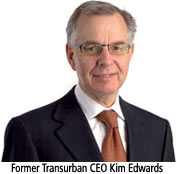 It took more than a year's worth of toll revenue on a Virginia highway just to pay a single employee of an Australian firm. Last year, Virginia motorists handed the Melbourne-based company that operates the Pocahontas Parkway near Richmond a total of $13.7 million in tolls and fees. The amount reflected a significant increase over the previous year as Transurban raised toll rates steeply in January, but it failed to cover the salary of CEO Kim Edwards who pocketed $9.2 million in bonuses and $5.2 million in termination benefits for his departure from the company in April. Combined with his salary, his total payout was A$16,664,532 (US $14,316,553).
Now that Edwards is gone, Virginia tolls do not even cover the multi-million dollar compensation packages offered to Transurban's top six executives. New CEO Chris Lynch takes the largest share with $3,839,783 in compensation. The other seven-figure employees take home the following in pay and other benefits:
- North America President Michael Kulper, $3,056,337
- Chief Financial Officer Chris Brant, $2,289,561
- Chief Operating Officer Brendan Bourke, $2,245,434
- Executive Vice President Ken Daley, $1,917,822
- Group General Manager P O'Shea, $1,764,101
- Total Compensation for key management: $34,651,427
Read the whole story HERE.
9/01/2008
YOU Paid Sen. Kirk Watson $450 an Hour! (Your Tax Dollars at Work!)
 It's Kirk Watson's world — You just live in it...
and pay him $450 an hour.
8/29/2008
More Tax Dollars and Debt - Sen. Watson Gets More Toll Roads for Austin
TxDOT to Get a Cash Infusion
The Texas Transportation Commission, taking its cue from state leaders, today decided to borrow another $1.5 billion that would be paid back by future gas taxes.
That borrowing authority, granted on a unanimous vote of the five-member commission in a specially called meeting this morning, will allow TxDOT to issue more than $4 billion in contracts this year. At least $1.1 billion of that would be for maintenance projects. But the remainder, almost $3 billion, would allow much greater spending to expand the state road system than in the fiscal year now ending, a year when TxDOT had to shelve many road projects.
That 2008 crunch directly affected the Austin area, where local leaders had approved a $1.45 billion plan to build five more toll roads based on a promise of several hundred million dollars from TxDOT. Politicians here, particularly state Sen. Kirk Watson, were incensed when TxDOT reneged on that promise only a few weeks after a tough October 2007 vote on the toll roads.
TxDOT executive director Amadeo Saenz could not say with certainty today whether the move to issue the $1.5 billion in gas tax bonds will restore all of that funding to Austin.
“It could help Austin,” Saenz said. “We want to make sure we get projects that are ready to go in 2009.”
The Central Texas Regional Mobility Authority will be building the first of those five projects, an expansion of U.S. 290 from Northeast Austin to Manor that would include toll express lanes and improved frontage roads. However, officials with the authority this week indicated that environmental and engineering work likely will not be ready in time for construction to begin until late 2009. That would be beyond the state’s fiscal 2009 year, which begins Monday.
Saenz indicated that some of the $1.5 billion would be spent on engineering and right of way purchases, readying projects in anticipation of even more borrowing authority to come. TxDOT could borrow an additional $1.4 billion against the gas tax in the 2009-2010 fiscal year. Austin’s projects could see some of that engineering money, or some of the $1.4 billion if TxDOT follows through and takes on that debt as well.
And if the Legislature passes additional legislation next year, the agency could borrow up to $5 billion more that voters approved under the Proposition 12 constitutional amendment in November. Those bonds would be paid back by general state revenue, not gas taxes.
Read the whole story HERE.
8/28/2008
Texas State Audit Report on TxDOT
The long anticipated audit report on TxDOT was released this morning. It includes TxDOT management’s response:
Post your comments.
Macquarie Shares Drop
UBS Cuts Its Macquarie Rating
By REBECCA THURLOW, The Wall Street Journal
SYDNEY -- Macquarie Group Ltd. shares fell 9.6%, touching a 3½-year low, after broker UBS AG cut its rating on the stock and warned the Australian investment bank's profit may be hit by asset write-downs.
UBS analysts cut their rating on Australia's biggest investment bank by revenue to "neutral" from "buy," slashing their price target to 48 Australian dollars (US$41.05) a share from A$60.
![[Combo]](http://s.wsj.net/public/resources/images/MI-AS105_MACQUA_NS_20080827220057.gif)
"With the global credit crunch and bear market entering its second year, and with little end in sight, we believe this is placing ongoing pressure on Macquarie's businesses and outlook," said UBS analysts Jonathan Mott, Chris Williams and Shu-Ling Liauw in a report.
Read the whole report HERE
Australian Toll Road Company Losing Millions
Australian Toll Road Company Losing Millions
by the Newspaper.com
Toll road operator Transurban posts a $140 million loss in the last year.
The financial outlook for tolling continues to be grim as one of the largest operators of toll roads in the United States and Australia announced today that it had suffered losses in excess of $292 million over the past two years. Despite charging Australian and American motorists $767 million in tolls and fees -- an increase of 34 percent -- in the year ended June 30, 2008, Transurban reported a loss of $140 million.
Read the whole story HERE.
8/27/2008
Costello Hits Krusee in Utah!
Texas Toll Road Advocate Has Fierce Critic
by Jeff Robinson, KCPW News (Salt Lake City, UT)
Last week, Utah lawmakers took advice on highway funding from Texas Representative Mike Krusee, who strongly advocated for the creation of toll roads. Krusee told legislators that Utah drivers are getting away with paying only a small fraction of what it costs the state when they drive on highways. But the lawmaker has fierce critics in his own state. An Austin, Texas resident calls him a con artist.
"Most folks don't oppose toll roads, which have been separate from our public highways," said Sal Costello. "What Krusee's done in Texas over the past few years is create a scheme that diverts our tax dollars intended for freeways into these double-tax tollways."
Costello founded the People for Efficient Transportation political action committee and blogs frequently about toll roads. He says people are paying double to use Texas toll roads because drivers are charged the gas tax they pay at the pump, then charged again at the tollbooth. He says the gas tax is inappropriately being diverted to toll roads.
Furthermore, Costello says the toll roads pushed by Representative Krusee are built on public rights-of-way that had been set aside for public expressways.
"The public highway right-of-way has been shifted to tollways, so there's this monopoly and people are sort of forced to pay this double tax," said Costello.
In 2005, the state's comptroller issued an extremely critical report about the Central Texas Regional Mobility Authority, which manages toll road creation in part of the state. It accused the agency of having no accountability.8/26/2008
San Antonio toll road authority members (with no toll roads) grab top salaries from taxpayers
Toll-road salaries top $1 million
by Patrick Driscoll, San Antonio Express-News
A local agency's salaries and benefits to plan and eventually operate toll roads will come to $1.2 million in the upcoming fiscal year, including two people yet to be hired.
 |
| (Alamo Regional Mobility Authority) |
Alamo Regional Mobility Authority leader Terry Brechtel will pull the highest pay — with a $177,407 base and up to $23,527 to cover a cost of living increase and a performance bonus.
|

The $200,934 total isn't too far from the $206,000 she made in 2004 as San Antonio's city manager, when she oversaw a $1.5 billion budget and 12,000 employees. She quit that job after a run-in with then-mayor Ed Garza.
Read the rest of the story HERE8/25/2008
Texas Monthly Says Investing Pension Funds into Texas Toll Roads Is Irresponsible and Immoral.
Investing pension funds in toll roads is an irresponsible–and immoral–idea
By Paul Burka, Texas Monthly
By Paul Burka, Texas Monthly
I doubt whether Rick Perry, David Dewhurst, or Tom Craddick has ever heard of the Lane Cove Tunnel in Sidney, Australia. If they had, they might not be so eager to raid the teacher and state employee retirement funds to build toll roads.
On the day the Olympics opened (08/08/08), the Sidney Morning Herald carried the news that the tunnel “is rapidly turning into a bottomless pit for its financial backers….” Two credit rating agencies, Standard & Poor’s and Moody’s, have warned that the toll road could default on its $1.1 billion debt with a year. The tunnel has suffered three consecutive monthly dropoffs in traffic usage. The estimated usage before the road was built was 100,000 vehicles per day; actual numbers in June and July barely exceeded 50,000. A Standard & Poor’s analyst predicted that unless the project gets fresh capital (at least half a billion dollars), it will default within 10 to 16 months. Perhaps TxDOT, since it is such a believer in such projects, would like to invest.
The problem with the financial wheeling and dealing with retirees’ funds that Perry, Dewhurst, and Craddick have proposed is that toll road projects are risky investments. They are risky for two reasons. One is that they are subject to economic fluctuations that affect people’s driving habits, such as the price of gasoline or the pace of development.
The second reason is that, when government is involved, they are vulnerable to political pressure and favoritism. Google “toll road defaults” and you will find a trove of stories with unhappy endings. The Camino Columbia toll road in Laredo, which was rife with political intrigue over which landowners would benefit from having a road go through their property, opened in 2000 and defaulted in 2004. Cost: $90 million. Auctioned off for: $12 million. Tx-DOT bail out acquisition payment: $20 million. The Dulles Greenway toll road to Washington’s Dulles Airport defaulted on its bonds within a year of its opening in 1995. The private owner, Toll Road Investors Partnership II, have lost money every year since the road opened. When toll roads lose money, tolls go up–in this case, to $4.80 by 2012. That works out to an astronomical 35 cents per mile. There are similar stories in Orange County, California (where the state had to buy failing toll lanes), and along Florida’s west coast, and near Richmond, Virginia, where the 8.8-mile Pocohantas Parkway, financed with tax-free bonds, has suffered around a 50% shortfall in projected toll receipts; the state has had to maintain the road because the private owners don’t have the money. Bond ratings have been lowered to below investment grade. To pay off the bonds, the toll was increased by 50%.
Read the rest of the article HERE.8/23/2008
Road tolls for blotto drivers?
Road tolls for blotto drivers?
From The Salt Lake Crawler:
Utah lawmakers were held spellbound by Texas Rep. Mike Krusee as he explained that toll roads provide solid and fair revenues for building highways. In a near swoon, business lobbyist-and-sometimes-Sen. Howie Stephenson purred:
Hearing you is a breath of fresh air. I just want to welcome you to the Socialist Republic of Utah.Apparently Krusee's breath wasn't so fresh to a Texas Highway Patrol trooper last spring.
Krusee, in fact, had passed up a court hearing on his drunken-driving arrest to be on Utah's Capitol hill.
Krusee’s attorney explained to the judge his client was unable to plead innocent in person because he was in Utah speaking to legislators. The trial is set for Nov. 17.
Krusee was arrested in April after a trooper saw Krusee’s car swerving down a highway near Austin. The Republican lawmaker, mug shot above, failed the field sobriety tests and refused a breath and blood test
Krusee is known in Texas for successfully sponsoring the “driver responsibility program” that includes surcharges for driving offenses, including $1,000 for a first conviction of driving while intoxicated.
8/22/2008
Radio Interview About Krusee's Double Tax Toll Schemes
Rep Mike Krusee has gone off to Utah to sell "freeway tolls". I just did an interview with a public radio reporter from Salt Lake City, Utah.
He saw my blog and wanted to know more about Krooked Krusee and his transportation "ideas". See my post below to get an idea of what I told him.
The story will be up on www.kcpw.org MONDAY.
The Games Politicos Play With Your Tax Dollars

Texas officials urge TxDOT
to issue $1.5B in bonds
for new roads
to issue $1.5B in bonds
for new roads
By MICHAEL A. LINDENBERGER, Dallas Morning News
Gov. Rick Perry has joined leaders of the Texas Legislature in calling on the state transportation department to immediately issue about $1.5 billion in bonds to pay for more roads, a step the governor and department officials have resisted for months.
In a joint letter issued today by the governor's office, Mr. Perry, Lt. Gov. David Dewhurst and House Speaker Tom Craddick urged transportation chairman Deirdre Delisi to take steps to issue the additional debt by as soon as September.
The extra debt has been a priority for lawmakers for nearly a year, ever since TxDOT began reining in spending as it confronted a long list of financial worries – from the growing construction costs, a soaring maintenance burden associated with Texas' aging roads, and a flat gas tax rate that hasn't been upped since 1991.
Despite those costs, and their own opposition to raising revenues, many lawmakers, including Mr. Dewhurst, accused TxDOT of painting an overly dire picture of its finances. The worry was that the poor-mouthing was aimed at weakening the legislature's opposition to toll roads as a new session looms in 2009.
For proof, many looked at the department's refusal to include in its financial plan the availability of the bonds, and to exclude another $5 billion in bonds made available by a constitutional amendment approved by voters last fall.
As TxDOT trimmed its spending, road projects got delayed across Texas, though in Dallas most of the impact was muted by the availability of money from the North Texas Tollway Authority.
Ms. Delisi, Mr. Perry's former chief of staff, insisted as recently as earlier this summer that issuing the extra debt without what she called a long-term solution would be irresponsible. TxDOT CFO James Bass warned that the bonds would cost so much interest over the next 20 years that their long-term effect would be negligible.
Gov. Perry, in an Austin speech in April, flatly refused to heed calls from Lt. Gov. Dewhurst and others to borrow more.
But Thursday's announcement changes all that, a spokesman for Gov. Perry said.
"The governor is tremendously pleased. We wanted a long-term solution," said spokeswoman Allison Castle.
Read the whole article HERE.
Sober Mike Krusee warms up for career as toll road lobbyist?

Most people don't oppose toll roads as they have been created in the US with toll roads supplementing our public highways.
What Rep. Mike Krusee has ushered in, in Texas is a scheme that diverts tax dollars intended for freeways into double tax freeways. Even worse, Krusee's new transportation scheme creates monopolistic tollways where freeways should be — as already taxpayer funded right of way (that were always promised as a public expressways) get converted into an unaccountable daily double tax (Says the Texas Comptroller's report) for drivers.
Krusee is a con artist with no college degree, and the yearly shifting source of income he states within public records is highly questionable. See my formal complaint to the Texas Ethics Commission about Krusee's source of income.
Read Texas Lawmaker Talks Toll Roads with Utah Legislature.
TxDOT Leadership In Denial
By Roger Baker
The ability to build and maintain roads is down nationwide. US travel volumes for June 2008 are down about 4% nationwide, year over year.
The latest Federal Highway Administration data for traffic volume trends in Texas compare June 2008 traffic volumes with June 2007:
Texas traffic volumes on Rural Arterial Roads: DOWN 4.2%
Texas traffic volumes on Urban Arterial Roads: DOWN 3.1%
Texas traffic volume changes on All Estimated Roads: DOWN 4.2%
But TxDOT remains in denial.
They probably want to believe that the recent reduction in oil price can continue. The reality is that world oil production has been stagnant for about three years now and price has gone down only because of reduced demand due to the depressed state of the economy.
Oil must continue to become less affordable, independent of its price, because less and less oil is being produced per capita worldwide and there is no inexpensive substitute.
8/20/2008
Krusee no-show on DWI arraignment
 Toller Rep. Mike "Swinger" Krusee, who was arrested for DUI a few months ago, failed to show up for his arraignment. Read about it in the Statesman HERE.
MORE TxDOT Tricks!
 "RPO’s are being pushed by TxDOT in an attempt to make the public believe that they are the same as the 391 Sub-Regional Planning Commissions." read about it HERE.
8/18/2008
TxDOT's Amadeo Saenz On Hot Seat — Can't Be Truthful
After 40 comments in July, and a request to repost for more comments here in August, I give you this repost. Join in on the comments!
Mix of campaign and family business draws criticism
A new AP report on Sen. Carona and others who have ethical conflicts HERE.
The report fails to mention the worst Central Texas toller of them all, in my opinion, Sen. Kirk Watson. Watson will run for a state office soon...watch out for this crook, warn your family and friends ahead of time.
8/15/2008
John "sweet jelly roll" Carona is a slumlord???
Senate Transportation Chairman's property management company skimps on maintenance and endangers property owners.
State senator involved in controversy over condos in danger of collapse.
By Lee McGuir, KHOU-TV (Houston)
For three years Dan Seluk and his wife Andrea have paid maintenance fees to the Park Memorial Condominiums. The same complex city inspectors now warn is in imminent danger of collapse.
The city says the parking garage might simply fall apart and take the dozens of condos that sit above the garage down with them.
But the condo’s management teams had been collecting those maintenance fees for years.“So you’re probably talking in three years about $15,000 in maintenance fees,” said condo resident Dan Seluk.The issue even had Houston’s mayor Wednesday wondering what had gone wrong.“The whole situation seems odd to me,” said Mayor Bill White.But he wasn’t the only one having doubts.“There’s a big question. Where have all our maintenance fees gone. Where have they gone?” said Andrew Seluk.
For a long time the money went to a company called Prime Site which was later absorbed by Associa Principal Management Group. In April that company ended its management agreement and copied at the bottom of the letter the company’s CEO, John Carona.
Carona is a state senator, but his day job is CEO of one of the largest property management companies in the nation. Until this summer his group managed the now-hazardous condominiums. He also wrote the Texas Residential Property Owners Protection Act.
“To think that someone in public office is running these companies and is perhaps making a lot of money. And the service of these companies is so terrible and the homeowner’s hands are tied.” said Dan Seluk.
Read the whole article HERE.
8/12/2008
Heiligenstein: "Whether or not it's a toll road or it's not a toll road is inconsequential."
Tolling 290: Neighbors Disagree on Highway
Newsroom KLBJ News Radio
People who use U.S. 290 east of U.S. 183 and west of the SH-130 toll road got to see an elaborate set of plans to upgrade the highway and add a toll road to it.
CLICK TO HEAR KLBJ'S JARROD ALLEN'S EXTENDED REPORT
This takes care of the worst of the bottlenecks. The toll facility ends up paying for the non-toll facility. All folks win in this deal," says Mike Heiligenstein, Executive Director of the Central Texas Regional Mobility Authority, which already oversees the 183-A toll road in Cedar Park.
He says the status of the highway makes little difference in the long run to east-side commuters. "Whether or not it's a toll road or it's not a toll road is inconsequential. Over the next twenty years, you're going to see development more than double."
But Dewy Brooks, the president of a homeowners' association in a subdivision right along U.S. 290, doesn't see it that way. "To take an existing road that's already there and turn it into a toll road and say it's an improvement, I have some issues with that," he says.
Heiligenstein says his agency has worked around Senator Kay Bailey-Hutchison's amendment banning current free roads from being turned into toll roads by keeping the frontage roads free of charge. In the past, the Texas Department of Transportation, a separate entity from the CTRMA, handling the 290 project, has taken a lot of heat from the public about plans to turn parts of Central Texas' highway system into toll roads.
Read the rest of the story HERE.
Read about Scumbag Mike Heiligenstein HERE.
8/08/2008
NASCO tells citizens to "get with the plan or get out of the way.”
Cox addresses speed limits, other considerations at TTC meeting
By ANDY HOGUE, Gainesville Daily Register
Though stalled in the water for now, discussion on the Trans-Texas Corridor 35 project continues, according to a report from Cooke County’s representative on the project.
Sheila Cox, who was a vocal opponent to the multi-modal toll road project when first presented to the public, was appointed to a regional corridor advisory committee last year. Cox submitted a summary of the advisory committee’s actions from July 23 in Austin, in which she said the project is far from being “dead.”
“... The TTC is still very much alive and continues as a threat to all Texans,” she said in her summary, which appeared in its entirety in the July 25 Register.
Read the rest of the article HERE.
8/06/2008
TxDOT gets 3 month "Stay"
Did you all see that the Sunset Review Commission has revised its schedule for acting on the TxDOT sunset review?
Apparently last month they pushed the decision date back for TxDOT 3 months! The meetings have been changed from September 23/24 to December 16/17. This also coincides with when the 2030 Committee reports back to the TxDOT commission in December on a re-estimation of transportation “needs”.
http://www.sunset.state.tx.us/meetingsch2008.pdf
http://www.dot.state.tx.us/2030_committee/default.htm
8/05/2008
Bush Calls for New Highway Tolls
By CHRISTOPHER CONKEY, Wall Street Journal
WASHINGTON -- The Bush administration unveiled a plan to impose new tolls on freeways and encourage more private investment to finance road and mass-transit projects, a move aimed at stirring debate as lawmakers prepare for a major overhaul of transportation policy.
Read the whole story HERE.
8/04/2008
Here's a good one (a repeat article) you must read again!
 (l-r) TxDOT Executive Director Amadeo Saenz,
and Chano Falcon, one of three TxDOT employees being
investigated by the FBI for bribery charges.
Well, it turns out that the AP missed the fact that Amadeo Saenz, TxDOT Executive Director, not only knows the three TxDOT employees who were indicted, but they are all “best friends”, according to an inside reelable source.
Expect “Saenz to resign” after Chano Falcon flips on him for his bribes, says source.
The quote Amadeo Saenz gave the AP would give the impression that he doesn't even know the three, who are now accused of bribery in an FBI case:
"Any allegation of wrong-doing by a member of the TxDOT family is saddening, but this incident renews my commitment to transparency and integrity in all that we do. I will continue to monitor this investigation and if necessary, will take the appropriate disciplinary action," said Amadeo Saenz, TxDOT executive director.This latest investigation by the FBI and the Texas Rangers is just scratching the surface of the real corruption in TxDOT.
One of the three indicted, Cresenciano "Chano" Falcon, maintenance administrator of Pharr District, “will do just about anything”, including bribes, back door deals and even flipping on his pal Amadeo Saenz, who is at the heart of the TxDOT corruption — just to get a better deal with the FBI, says my source. Chano Falcon, Amadeo Saenz, and Ray Llanes hang out and go to bar-b-ques and other parties together says source.
As I’ve been saying for years, the TxDOT culture is poisoned with insider deals and bribes, and the folks at the top like Amadeo Saenz are the worst. This culture of fraud and waste is one of the reasons TxDOT wants a whole new source of revenue, they get directly — the toll tax for driving on tax funded freeways.
UPDATE: Saenz joined TxDOT in the Pharr District in 1978. He was the Pharr district engineer from 1993 to 2001. From 2001 to 2007, Saenz was TxDOT's assistant executive director, until he became the executive director on October 1, 2007.
8/01/2008
GAO Questions Wisdom of Public Private Partnerships
GAO Questions Wisdom of Public Private Partnerships
Government Accountability Office testimony warns of need to better assess the true cost of privately operated toll roads.
by TheNewspaper.com
Government Accountability Office testimony warns of need to better assess the true cost of privately operated toll roads.
 The Government Accountability Office last week questioned the wisdom of using public-private partnerships to build and maintain toll roads. GAO's Director of Physical Infrastructure issues, Jay Etta Z. Hecker, summarized the congressional watchdog agency's work in testimony before a US Senate Finance subcommittee hearing on Thursday that focused on the cost to the public of privately operated toll road leasing arrangements.
Broadly speaking, these arrangements allow private companies to lease existing roads in return for the ability to collect toll revenue for a fixed term that can last up to 99 years. In some cases, these companies will offer local politicians billions of dollars in up-front cash payments for leasing rights. The private company would then be responsible for maintaining the road. In other cases, the private company would build and own entirely new roads, delivering significant new highway capacity to the public in return for significant profit potential.
While acknowledging potential public benefits of private participation in these deals, Hecker said that GAO's extensive study of this funding approach identified a number of fundamental problems.
"There is no 'free' money in public-private partnerships," GAO's report stated. "They are potentially more costly to the public and it is likely that tolls on a privately operated highway will increase to a greater extent than they would on a publicly operated toll road. There is also the risk of tolls being set that exceed the costs of the facility, including a reasonable rate of return, should a private concessionaire gain market power because of the lack of viable travel alternatives."
Read the rest of the article HERE
Subscribe to:
Posts (Atom)


